Tuesday, October 27, 2009

The most common discussion during a crisis is how to stimulate the economy in order to pass the recession or crisis. Even if economic theory considers a crisis as a necessary evil in order to readjust certain parts of the economy and to enable a fresh start, most of the people dislike these periods and politicians do their best to restore confidence.

However, most of the political action targets businesses. Thanks to subsidies governments ask companies to not lay-off part of their workforce and support those companies in international trades. Temporary tax cuts or cash-injections are part of that "treatment". The goal is to encourage companies to invest further.

But do these measures tackle the right problem? Where is the real problem during a slump? It is not quite the businesses that are the trouble makers here but consumers are. They lose their confidence and spend less. Consumption decreases due to their lack of confidence. Due to this, companies sell fewer goods and services. Selling fewer goods means that they need to cut their costs in order to stay profitable. This means that they will decrease the production volume (fewer orders to suppliers, lower energy consumption, need of fewer workers to produce goods...) and hold back any investment plans. This postponement hits some more suppliers (for instance construction companies or machinery suppliers).

Helping the companies is certainly a good thing to do and makes sense politically speaking because it is always good to know that the industry is happy with the current government. This will potentially safe jobs in the future and make re-election of the government more likely.

But still, it doesn't tackle the issue of consumer spending. How can a government influence consumer spending? You might think of taxes and it is surely the easiest way to influence the amount of money the taxpayer has in his or her pocket. Today, income tax is based on our income (seems logic). By simply lowering the income tax, we would add some incentives to spend more money. But this is not enough.

Let's consider a completely new approach to income tax. Let us call it the savings tax. Instead of taking the tax from the disposable income, the government would base the tax on the income that has not been spent. That means, if a household has spent all of their income, they would not pay (saving or income) taxes. If they decide not to spend all of their money, the tax would be based on the amount that has not been spent. Does that mean that people have no longer the right to put money aside? No, of course not, they can put as much money aside as they wish, but they have to pay taxes on it.

A few things should be exempt from the savings tax though. Putting money aside for the retirement is a good thing and should be supported. Thus a special account will be created where each person can put as much money on as they wish. This money will not be taxed but can only be used for a special (and authorized) purpose, such as retirement. Certain kind of spending can also be supported. If a household spends a certain amount per month or year on education or culture, they have a lower tax on their savings. This encourages people to consider their spending and use more for child education.

The system does therefore not penalize savings that have been made for a legitimate purpose and encourages people to spend all their money. There are few incentives to save. The state would recover from the loss of the income tax revenue by collecting more money from corporate taxes (thanks to higher EBITs) and VAT.

Friday, July 17, 2009

Inflation vs deflation

We are currently facing a heated debate whether we have a risk of deflation or inflation. Not that this is a passionate subject for most of the people but it might well influence our future – especially our purchasing power. What do we know about these two? We know that deflation is that kind of thing which the Japanese have been facing for a decade or so already. Do they seem unhappy? When they travel around and block our inner cities with their tourist busses they all seem quite happy. What about inflation? That’s that kind of stuff which is going on in Zimbabwe: the government issued on January 16th a ZWD 100 trillion bill. You can be a millionaire so quickly!!

The problem is that, as a citizen of one of these countries or as a corporation, we do not really think that this is funny. Why? Because if we receive a bill of LCY[1] 100 and some days it is only worth 90 we are rather pissed. This is inflation. Inflation makes things more expensive and thus we can buy less with our 100. Deflation is more complicated. Consider that you are the head of XYZ Inc. and that you want to make an investment in Yokohama. Today that investment costs you JPY100, tomorrow probably JPY90. What will you do? Yeah right, you’d probably wait. But the thing is that once the investment would cost JPY90 today it would cost JPY80 tomorrow, so you keep on waiting. That’s pretty embarrassing for the country because suddenly no one is investing because prices are falling. It is a vicious circle because for prices to rise again, someone would need to invest. But because no one does so prices keep on falling.

So to keep it simple, inflation is caused because too many people are spending too much money and deflation is that too many people are not spending anything. Thanks to globalization all this becomes somewhat complicated. Investors can transfer funds from place A to place B quite easily. Inflation is low in Japan, the Central Bank lowered interest rates to 0 and thus investors enter the market to take on a credit and invest it in a country with a higher inflation such as the US a couple of years ago. The difference they made was their gain. The trade is called a carry trade. Normally the exchange rate is going to prevent that kind of trade from happening but exchange rates are not always free-floating which gives place to arbitrage opportunities.

Are we now facing deflation or inflation? What should the Central Banks policy be?

According to some inflation can only be caused when consumers are spending more nominal dollars. They argue that the state has so far been reluctant to pure money to consumers’ pockets and thus the risk of inflation is low. The state funds consist basically in guarantees meaning that there is most of the time no exchange of cash. Consequently, there can not be inflation. They argue that the bigger threat is deflation. Consumers stop spending, companies stop investing, employment rises and a downward pressure on prices is exerted.

If the crisis continues and recession deepens, deflation becomes a real threat. Drying liquidity causes deflation, money is hold back by consumers as well as lenders. Mr. Bernanke said in 2002 that a healthy banking system is the best defense against deflation. The banks now being in a shaky situation, the economy can no longer rely on that defense. Thus the risk of deflation increased significantly.
All also depends on the currency. If the LCY is getting stronger, import prices are decreasing which adds deflationary pressure on prices.

Today, the money-in-circulation is not so much of a problem because so far the consumers are careful and lenders are keeping their money. According to an article published in the Wall Street Journal, the M1 aggregate rose so far by 10%. The biggest problem comes from the bank reserves. Banks now have huge reserves enabling them to make new loans. The question is now how quickly do the banks make these loans? Consider that banks are hungry for new business and make loans quickly in order to have higher returns. Money-in-circulation skyrockets and creates inflation. The phenomenon is even intensified by the low demand – due to high unemployment and low investments - and high supply of money.

Some more factors do enter into the inflation figure: commodity prices. Commodities are the basic element of all products. If commodity prices rise – what they are doing again since May – product prices might follow. Why do commodity prices rise? So far analysts expect the Asian economies, especially China, to recover from the crisis. According to Chinese newspapers, Chinese industrial production rose by 8.9% in May. This is a sign that the economy is recovering but especially an indication that Chinese manufacturers are starting again to import raw materials which pushes up prices again.

Gold price which is usually considered as an indicator for inflation has been pretty volatile during the recent weeks probably indicating that investors are considering the risk of inflation. Inflation indexed bonds also start pricing in an increase of inflation. Especially the 10yr bonds are showing some sensitivity to that issue (they currently price in an inflation of 2%).
It is therefore probably safer to say that there will be inflation. Not now but in the next years and if the Central Banks do not take the necessary steps – such as reducing the money-in-circulation by increasing the reserve requirements for banks – we might see a strong and persistent inflation. This damages parts of our economy. For sure it would be unwise to say that deflation is not going to happen but the chances that we enter a deflationary cycle are pretty low. Finally everything depends on the
[1] LCY = Local Currency ; FCY = Foreign Currency

Tuesday, December 09, 2008

Mass hysteria

The world is suffering. The Western economies are slithering into a recession, maybe a severe depression and no one dares to question the apparent fact the everything is going to be worse. We read it every day, newspapers seem to predict the apparent death of capitalism, television shows us how badly we will suffer and radio is playing one requiem after another.

Chased by these messages, people start feeling shaky and they start fearing that the promised catastrophe will also affect them and their standard of living. They will all be laid off, will face dearth and everyone will have to move to new kind of slum. Slums for fallen stars.

However, we should have a more objective look on how things work. The financial crisis had its ruthless effects, billions were lost and the system suffered. But initially the shock remained something particular to the financial industry. Banks, insurances, funds and all other kind of investors got convinced by something wonderful. A security offering stable cash flows and a high yield. These securities were based on different kind of mortgages, some quite risky, others less. Investors could choose whether they would like to invest in a riskier part or if they would like to remain conservative.

In the meanwhile, hard working people would bring their money to banks in order to invest it. Their goal? Receive interests, put money to work. Banks offering lower interest rates suddenly saw their clients and potential clients walking away to other banks. These other banks offered higher interest rates, and consequently they needed to invest the money into higher return securities. Banks being under the pressure of offering higher returns to their clients, because clients asked for such returns, entered the field of seemingly safe securities. Lacking the necessary experience, however, to understand what factors influence the intrinsic value of these securities, these banks became a dangerous, because unconscious, player on the market.

When house prices started to collapse, some homeowners had difficulties to pay their interest rates and therefore the initially and apparently stable cash-flow started to become suddenly unstable and unpredictable. Unconscious players, instead of remaining calm, started to sell of all their securities, some other players, the very few smart ones knowing that a big slump was going to come, also sold of all their Mortgage Backed Securities (MBS). Facing this huge wave of sales, prices necessarily started to collapse and no one would dare to buy MBS, putting their price close to 0.

Does this mean that this money is lost? No. Does this mean that banks will go bankrupt? No. It simply meant that the stream of cash-flow is interrupted for a certain period of time. As soon as people are able to pay off their loan again, the cash flow will recover and the investor receives its money.

If this would be so, why are so many banks facing difficulties? Let us call it “mass hysteria”. People get scared when their bank is facing some troubles and they take back their savings, give these savings to another bank or keep it under the mattress. A bank, having only a very small proportion of the savings, in their account as available funds, faces difficulties paying back all the money. A bank usually receives money and lends it to other people. It cannot ask these people to pay back the loan right now, only because some others would like to have their money back. The bank therefore faces bankruptcy.
You might want to chip in with the fact that this only happened to a couple of banks, the others being untouched by the bank runs. Sure. But a bank run can take several forms and what we actually saw was not a mass bank run but a dying interbank market. Indeed, it was not the clients who took away their money, but it was the other banks that stopped lending their money.

Why was that so? It was so, because the cash-flow was interrupted. And no one knew when it would recover. But it would recover, right? Let’s look back to the functioning of the MBS. It is like a normal loan, only packaged and sold to a third person. Neither very unusual, nor very complicated to understand. However, our accounting rules force banks to declare the market value of the securities on their balance sheets. The balance sheets being the main reference for investors, banks were reluctant to put on the “losses” of their MBS on their sheets. Law being law, they needed to put these on and needed to write-down billions and billions of dollars.

That’s certainly unfair to everyone, because no one knows if these securities are really worthless. Most certainly they are not worthless. But that’s the rule.

But what about the real economy? How did it get into trouble? You might say because banks weren’t lending so much. Probably this is only a small reason for the slump we are currently facing. The main reason would be closer to this statement: because slump is fashion. That might sound weird but let me explain a few things.

All our system is, of course, based on human beings. Each of us has a mind and thinks independently. Consequently, economy is based on our psychology. There is no such thing as a purely rationale thinking person, everyone has feelings and therefore everyone is partly irrational and special in a certain way. However, thinking makes us feel tired. We love to listen to others and simply accept what they say. Those people are not questioning whether it is true or not what their speaker said, as soon as it sounds easy to understand, they accept it.

Now, let’s go back to the first paragraph of this article. We open the newspaper, we switch on television or radio, we go online and we will always see the same message. The message saying: recession, depression, slump, fear, stock prices falling. Having almost no one saying the opposite, people accept what they hear, read and see. People start getting angry at the system and they stop consuming, fearing that they might be part of the next wave of lay-offs. By doing so, by simply accepting the message, that everyone is going towards hell, and by getting feared, we actually create the slump.

We create the slump, because suddenly there is no more consumption. No one wants to buy cars and no one is ready to make an investment. Although we still have the money to do so. But because others do not spend their money, we better keep it as well. Newspapers write about the slump, because the others do so. We are in a vicious circle and this vicious circle leads directly into a recession. Recession based on a fashion still, but it remains a recession.

Politicians predict that 2009 will be a bad year. By saying so, citizens safe even more and spend even less. We are in the classic case of a self realizing anticipation. Because we anticipate the downturn, and because we react as if the crisis would already be with us, it will inevitably come. Let’s have an example for a self realizing anticipation: we own a stock, we anticipate the stock to lose value and sell it. Buy selling it, the price of the stock drops. Our action caused the drop and therefore our anticipation became true thanks or due to our acting.

It is safe to say that we are accompanying the downturn, that we are most certainly responsible as well. No one has wished it but everyone has a share of responsibility. Now we have to life with it.

Monday, December 03, 2007

Stayin’ Alive: A Guide for the Summer Analyst or Associate

Let’s say you actually care about whether you do well at your summer program. Then…
  • Don’t complain about your projects. Get staffed on a shit job? Everyone has worked on a shitty project, including the people you are working for. The worst thing you can do is echo someone who is negative around you.
  • Think of your internship as a 2-month long interview process. You wouldn’t tell the interviewer that you don’t like a certain part of the interview.
  • Befriend the staffer.
  • Show up earlier than the people you work for. If you’re a summer associate, show up earlier than the VPs or MDs.
  • Face time does count. Don’t leave earlier than 8pm, and for weekends, do as others do.
  • Don’t eat meat? Vegetarians don’t belong in finance. And if you want to say that you don’t drink, you might as well say that you don’t have sex.
  • Socialize with your colleagues. As for going beyond formally planned activities and reaching out to other (non interns) — let them reach out to you. If someone asked me to go out for a drink — I wouldn’t think negatively of that person, I’d just think of a reason not to go.
  • Expenses — just follow policy.
  • People find out if you’re hooking up with another intern. It’s considered puerile, but happens all the time. It’s not like dating another ibanker is considered prestigious. If you’re hooking up with a model, on the other hand… And if you’re a girl, you’re writing yourself into the ’slut’ category.
  • When it comes to dress, you definitely want to fit in, but on the upper end of fitting in. You should dress well for interviews, however.
  • Lastly, you want to create bonds with people who are going to pull for you when it comes to hiring time. Think about that.

Monday, October 29, 2007

Thermador Groupe est spécialisé dans la distribution de produits plombiers en France. Son Chiffre d’Affaires se reparti aujourd’hui dans plusieurs domaines précises : les pompes (27,5%), les produits de robinetterie (23,3%), les accessoires de chauffage (17,6%), les tubes en matériaux de synthèse (12,6%) et les matériels de motorisation (4,6%). Le groupe connaît une évolution stable depuis des années, ce qui s’exprime par une croissance du bénéfice par action constante depuis 2003. Cherchant à se diversifier, le groupe a commencé à élargir son activité en entrant dans les marchés d’Europe de l’Est.

Malgré une bonne performance au premier semestre, l’entreprise semble être touchée par les mouvements des marchés financiers et la crise de l’économie française. Le Chiffre d’Affaires est toujours en hausse de 9% par rapport à l’année précédente, mais reste loin derrière l’excellent Chiffre d’Affaires du premier trimestre (+30%). Ceci est la conséquence d’une économie française en difficultés. Le secteur de la construction voit sa croissance ralentir, la demande des matériaux de constructions baisse et avec cela les ventes de Thermador Groupe. De plus, une hausse des matières premières, surtout du cuivre, met l’entreprise dans une situation ambiguë, entre les fournisseurs cherchant à répercuter cette hausse des prix sur les prix de vente de leurs produits, et les clients qui cherchent à diminuer leurs coûts.

Une hausse de 15% du Chiffres d’Affaires sur l’ensemble de l’année 2007 est réalisable, mais l’année risque de se terminer moins bien que prévu, si l’économie française reste en difficultés. La tendance du titre est donc neutre.

Monday, May 14, 2007


The Chinese bubble

Nowadays China plays an important role in our world economy. Its imports and exports heavily influence the world economy and every sign of a weakness has influences on stockmarkets everywhere. This year the Chinese stockmarkets already slumped twice and each time it took the other stockmarkets temporarily down. A study of stock-market history conducted a few years ago (by economists at Yale University) confirmed that global markets are far more correlated now than they used to be, which means that emerging markets like China can have a profound effect on asset prices world wide.


The Chinese economy is booming but the question is how stable is its financial system?

The population does not know so much about stockmarkets. They see that investors make enormous profits and decide that they want to be part of this rally to fortune. They consider the markets more than a gamble, not considering the risks related to their investment. This is due to the lack of education and the lack of experience. Stockmarkets are something quite new for the Chinese population, before these markets have not been easy to access. Today, it is in many ways easier to invest money on the stockmarket and China is not alone with the dilemma of a not-informed population. Vietnam faces the same challenge and so do other neighbouring countries.

This is not surprising. China currently faces it’s biggest-ever stockmarket boom. Everyone, from students to retirees, enters the race supported by the easiness of borrowing money. With inflation at 3.3% the real interest rates are around zero this year which encouraged the withdrawal of savings from banks. People also have wider access to money through mortgages or pawnable assets.

Nothing seems to stop this run, and governmental measures are until present without a great impact due to the poor financial infrastructure which makes it difficult to influence the markets.

What happens now if the market would plummet? The impact on the social stability would be inestimable if the bubble would pop. Low income groups as students and retirees are involved in the current stockmarket boom and if those people would loose their money, they would probably turn their anger on the party.

Today there are 91 million accounts held by individuals at brokers or in mutual funds and in average 200,000 new accounts are opened each day. All this in an environment which has obvious signs of becoming overheated.

Share prices are moving far ahead of companies’ earnings, to a degree scarily reminiscent of Japan in the late 1980s just before its crash. Shanghai’s stocks rose 130% in 2006 and continue to climb.

It is said that there are too few institutional investors because the government continues to impose restrictions on how far for instance insurance companies can invest their money. This leaves the market mainly to individual investors facing listed companies with poor corporate governance and consequently increasing risks of market-jarring scandals.

Is it time to be worried? Since 2004 there are economists claiming that China’s bubble will burst one day. Overinvestment will lead to over production and to an economic crisis. Even though this might be unlikely to happen for the moment, it is possible that the financial market will readjust itself. This means that there will be a certain number of losses and a certain number of losers. It should be interesting to watch the evolution closely and to see how the Chinese government will react face to this situation.

Monday, March 19, 2007

I asked a friend from Russia to comment my article because I wanted to have an insider view on this story. Here is her comment, I very much appreciate it:

Hi, Michael!Well, that's an interesting view on international geopolitics concerning Russia. But I have few comments. Nobody needs the second Cold War,including Russia.But like any country, Ryssia would like to be heard by the other countries at least after such a long period of ignoring of its interests. And that doesn't mean that it climbs to world power. But taking into account such factors as world globalisation, economic recession in the american economy, huge prices for oil, gas and energy carriers, like any country having any influence instruments (oil resources in this case),Russia aims at improving its position in the world geopolitics, but not at dominating in the world. And that's normal for any country. Especially for the biggest one in the world. Russia just shows its independence from american influence and that's all. For sure Russia still have some internal problems, but it has to build normal market economy for 20 years the time when other countries had 200 years for that. For sure it makes mistakes like any country made through all its history. Nobody talks about second cold war. Russia just would like to play in the world geopolitics without anyone's orders. That's the deal.

Thursday, March 01, 2007


The source of my last article is mostly The Economist, the printed version. However, there are also articles available online.

Not a cold war, but a cold tiff

Feb 15th 2007 | MOSCOW
From The Economist print edition


Here are some sentences from this article:

  • Concerning what Mr. Putin said:
"The world, Mr Putin added, was witnessing “an almost uncontained hyper use of force”, which was plunging it into “an abyss of permanent conflicts”. Lest anyone mistake him, he specified that “the United States has overstepped its national borders in every way,” exhibiting “a greater and greater disdain” for international law."

  • Concerning the efforts to enlarge its influence on neighbours:
"The Russians saw their defeat in Ukraine as evidence of perfidious American meddling in Russia's sphere of influence. For the Americans, the debacle showed that a truth plain in Mr Putin's domestic policies—that he was not a real democrat—would affect his country's foreign behaviour too."

  • Concerning the economic power:
"It [Russia] has the biggest hydrocarbon reserves in the world, which can be used as “tools of intimidation and blackmail”, as Dick Cheney alleged in an aggressive speech in Vilnius in May 2006, to which Mr Putin's Munich address was in part a riposte. It has lots of nuclear arms to underpin its self-esteem. But it does not have the conventional forces, nor the economic and ideological resources to compete with America globally as it did in the cold war."

  • Concerning the american influence in Russia:
"He [Putin] again insisted that non-governmental organisations active in Russia but funded from abroad were the tools of foreign governments."

Another article states the following:

Russia and the Middle East

The bear is happy to be back

Feb 8th 2007 | CAIRO
From The Economist print edition


  • Cold War:
"[...] Last summer's fight between Israel and the Lebanese guerrilla group Hizbullah echoed the cold war: a clash between proxy forces that tested armaments and tactics. While Israel's American-supplied gadgetry was far more lethal, Hizbullah's Russian weapons were effective too. Its anti-tank missiles knocked out scores of Israel's armoured vehicles."

  • Influence on other countries:
"After Russia secured a $7.5 billion deal to supply Algeria with fighter aircraft, tanks and anti-aircraft missiles, its army chief of staff, Yuri Baluyevsky, recently echoed Mr Putin, saying that the American effort to create “a unipolar world” was fomenting crisis."

  • Iran:
"Russia would like to think that the recent slight softening of Iran's public tone and the rising domestic criticism of its president, Mahmoud Ahmadinejad, may owe something to fears of losing its only legitimate outside source of nuclear technology [Russia]."

These citations aim only to underline what I said in my previous article. It doesn't mean that everything is right or wrong. It is interesting to follow the last evolutions.
Recently Russia has shown its interest to buy parts of EADS, Europe's pride. It is not very likely, in my opinion, that France and Germany will agree to those plans, but it clearly shows that Russia wants to enlarge its global influence. It seems to be obvious that Mr. Putin wants to make out of Russia a new superpower, opposing or challenging the United States of America.

But Russia is not the only important new player on a geopolitical basis. China is also eager to play the role of the new political superstar.

Wednesday, February 28, 2007


A new Cold War! We lived the end of the first cold war, are we going to live the beginning of the next episode?

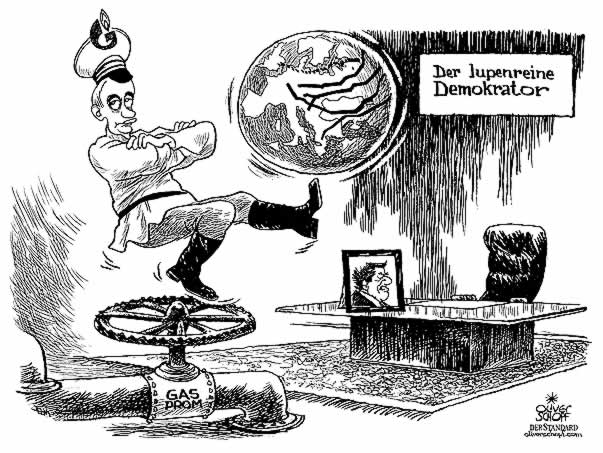
Russia lost a lot of its power at the end of the first Cold War. They went from one crisis to another, their empire busted into pieces. Russia wasn't able to really prove its strength until recently. The last years the new Russia came back on the international platform, playing with its muscles. The hands in its neighbouring countries like Belarus, Georgia and Ukraine shows that they are starting to stop sleeping.

Iran. Powerless until the moment where an international power backs their plans, and confirms that they believe in Iran's honesty. Who is this international power? Of course, Russia is. They supported Iran, not only because they have economic interest in the region (everyone actually has this) but because Russia turns the wheel now. However, by letting the last UN resolution and as a consequence the sanctions against Iran pass Russia showed that Iran has to be careful in handling with them. It is Russia which dictates the rules and not Iran.

Russia also plays with Europe. Europe, as one of the leading economies, needs energy. And a huge part of this energy comes from Russia. Until present the lobbies have discouraged the politicians from changing anything of their energy policy because they feared losing money. The consequence could be now that every one of Europe's habitants will lose money. We have now higher energy prices due to the pressure of Russia, which also pressures Iran, which itsself has a lot of influence in Iraq and other countries in the Middle East.
China on the other side is the laughing third, accepting Russia's energy with open arms and willing to pay the right price for it...But can China really go this way? Can they mess up with Europe by accepting Russia's gamble for power? Europe represents an enormous market and the consequences of an "angry" Europe, installing import tariffs and other barriers could delete the economic advantage of cheap production in China...companies would rather go to Vietnam or other South-East Asian countries.

However, Iran and Russia, two players, some years before not in our minds, now present in every single newspaper. The last meeting of the Middle East quartet (EU, USA, UN, Russia) in Berlin this week Russia and USA came pretty close to a conflict, disagreeing on the new government to be formed in Palestine.

But can Russia afford such a conflict? Are they economical stable enough to really support a new Cold War? To answer this question we should ask ourselves if they ever have been strong enough to be a global player. Economically they have never been such a big superpower. Sure, their industry and their military-industry has been enormous but by the end their system collapsed because they simply forgot about the people living in their state. Those people wanted more freedom and where freedom is there can be no Cold War because it would need propaganda to create support in their own population. Being shut from the outside like North Korea, Russia would never do this or could never afford such a situation. Aren't they also depended on our knowledge, our machinery and technology?

There could be an endlessly discussion on this subject. But what is clear from now on is that Russia is back on the international scene. It is the comeback of the former Popstar. Russia is seeking to become a superpower again and aren't they on a good way?

Monday, November 27, 2006

This blog has been created some months ago, unfortunately I never really had the time to take care of this space. Now things changed and I finally have some time to manage this blog and to write some articles.

I would like to create an interactive blog, which means that I would like to create a discussion. I don't want to publish articles and don't receive any response but instead I would like you to post your comments and/or write me emails with your articles and I will publish them here for you. I will try to update this blog as often as I can and will deliver you up to date information and sources.

Have fun reading and writing about your favorite subjects, going from economics and politics to culture and social subjects.

If you want, you can also have a look at my other blog (
http://leowilmich.skyblog.com) and have a look at all the pictures from all my different trips.